Unlock what is conversational intelligence: A quick guide
Let's get straight to it: Conversational intelligence (CI) is a type of AI that records, transcribes, and analyzes business conversations to pull out insights you can actually use.
Think of it like a coach reviewing game footage for a sports team. Instead of watching plays, it "watches" your sales calls, support chats, and video meetings. It takes all that unstructured dialogue—just people talking—and turns it into organized, searchable data.
The Core Function of Conversational Intelligence
At its heart, conversational intelligence is about listening, but on a massive scale. A single sales manager can maybe listen to a handful of calls a week. A CI platform, on the other hand, can process thousands. It spots patterns, trends, and crucial moments that would otherwise be completely missed.
But this is way more than just recording calls. The technology acts as a data-driven coach for your entire team. It shows you exactly what your top performers are doing differently, flags the most common customer objections as they pop up, and tells you which marketing messages are actually landing with real people.
By digging into the details of a conversation—like sentiment, tone of voice, and specific keywords—you can finally stop guessing and start building strategies based on what’s really happening.
From Words to Wisdom
The main goal here is to transform everyday conversations from a simple record of what was said into a strategic asset. To do that, CI platforms focus on a few key jobs:
- Transcription and Analysis: It starts by turning spoken words into text. Then, it combs through that text to identify topics, questions, and mentions of your competitors.
- Sentiment Tracking: The technology can gauge the emotional tone of a conversation, helping you understand if a customer is happy, frustrated, or somewhere in between.
- Pattern Recognition: By looking across thousands of interactions, it finds recurring themes. This could be anything from a bug in your software to a new market trend.
Conversational intelligence isn't about spying on your team. It’s about giving them the objective feedback they need to sharpen their skills, truly understand customers, and drive more revenue.
The impact of this technology is hard to ignore. The conversational intelligence software market was valued at $22.89 billion and is expected to nearly double, hitting almost $49.52 billion by 2032. Read the full research about this market growth.
This massive growth shows a big shift in how businesses think about their customer interactions. Companies now realize their daily conversations are a goldmine of data. CI fits into a much larger strategy of knowing your audience, which is what customer intelligence platforms are all about. To see it in action, just look at how chatbots for enterprise use similar analysis to handle automated interactions.
Conversational Intelligence vs Conversational AI
It’s easy to mix up Conversational Intelligence (CI) and Conversational AI, but they do very different jobs. One is about listening and analyzing, while the other is about talking and interacting.
Here's a simple breakdown to clear things up:
| Aspect | Conversational Intelligence (CI) | Conversational AI |
|---|---|---|
| Primary Goal | To analyze conversations for insights. | To simulate human conversation. |
| Core Function | Listens, transcribes, and identifies patterns. | Interacts, responds to queries, and performs tasks. |
| Who Uses It? | Sales, support, and marketing teams. | Customers and end-users. |
| Example | A platform that reviews sales calls to find top-performing talk tracks. | A chatbot on a website that answers customer questions. |
| Analogy | A sports analyst reviewing game film. | A robot player on the field. |
Essentially, CI is the "ears" that help you understand what's being said, while Conversational AI is the "mouth" that allows a machine to talk back. They can work together, but they serve fundamentally different purposes.
How the Technology Actually Works
So, how does a platform turn a simple phone call into a goldmine of strategic data? The whole process is about taking messy, unstructured dialogue and turning it into clean, actionable intelligence. It all begins by capturing the raw material—your team's daily interactions.
Conversational intelligence platforms securely record and pull in data from all over the place. This includes audio from phone calls, video from virtual meetings, and even text from emails and chats. The goal is to get a complete 360-degree view of every customer touchpoint before any analysis begins.
From there, the first layer of tech kicks in. Advanced speech-to-text engines get to work, transcribing audio from calls and meetings with surprising accuracy. This creates a clean, searchable text version of the entire conversation, which becomes the foundation for everything that follows. But a simple transcript is just the starting point.
The Magic of Natural Language Processing
The real power of conversational intelligence comes from Natural Language Processing (NLP). Think of NLP as a detective poring over the transcript, looking for clues. It doesn't just see words; it understands their meaning, context, sentiment, and the intent hiding behind them.
For instance, NLP can easily tell the difference between a customer casually mentioning a competitor versus one who is seriously considering their offer. It flags specific topics, keeps track of who is speaking, and can even gauge the emotional tone of the conversation.
The core job of NLP here is to add layers of meaning to the raw text. It figures out not just what was said, but how it was said and why it actually matters to the business.
This flow shows how raw conversations get captured, analyzed, and finally transformed into insights you can actually use.
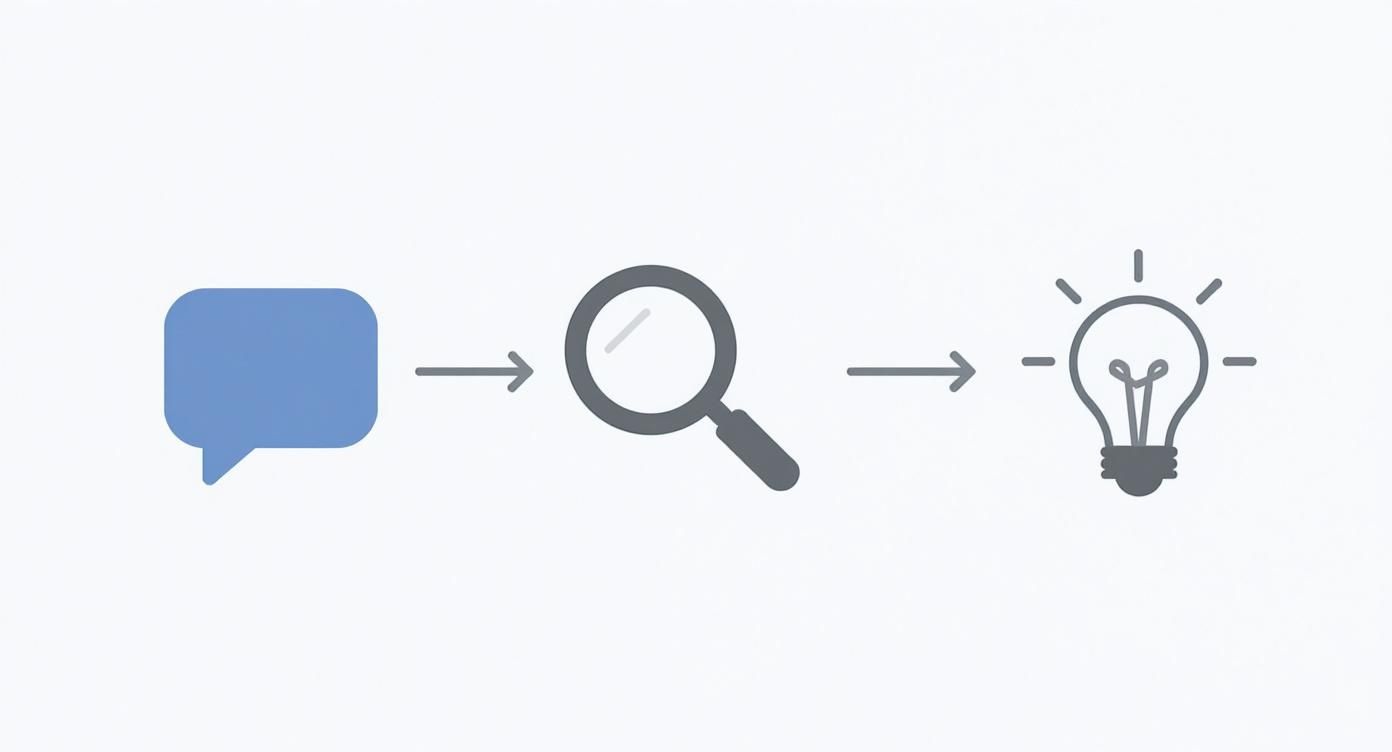
This visual journey from simple dialogue to strategic intelligence is the backbone of any solid CI platform.
From Analysis to Actionable Insights
Once NLP has done its work enriching the transcripts, machine learning (ML) algorithms take over. These sophisticated models are trained to sift through thousands of analyzed conversations to spot the kind of large-scale patterns and trends a human could never hope to see.
This is where the platform generates its most valuable output:
- Pattern Recognition: ML is great at identifying recurring objections, pinpointing successful talk tracks used by your top reps, and highlighting common customer pain points.
- Risk Identification: The algorithms can flag calls where a customer sounds frustrated or mentions churning, giving managers a heads-up to jump in and help.
- Predictive Analytics: Over time, the system can even start to predict outcomes based on conversational cues, helping your team forecast more accurately.
This multi-step journey—from capturing raw data to transcribing it, analyzing it with NLP, and spotting patterns with ML—is how conversational intelligence turns everyday business chats into a powerful source of strategic insight. It’s what drives smarter coaching, sharper messaging, and much better business outcomes.
Unlocking Key Business Benefits with CI
Forget the tech jargon for a second. The real story behind conversational intelligence is the massive business impact it delivers. When you can finally understand what’s happening in every single customer conversation, every department gets a serious advantage. It’s all about turning everyday chats from simple back-and-forths into strategic goldmines.
For sales teams, CI is a game-changer—a coaching engine that never sleeps. It helps close the performance gap between your top reps and everyone else by creating a searchable library of "game-winning" moments. Managers can pinpoint exactly how their best sellers handle tough pricing objections or navigate tricky negotiations, then turn those moments into training everyone can learn from.
This data-first approach slashes the ramp-up time for new hires and makes sure the whole team is using the most effective talk tracks. The result? A sales process that’s more consistent, more predictable, and a lot more successful.
Fueling Smarter Marketing and Service
Marketing teams get a direct line into the unfiltered voice of the customer. Instead of just relying on surveys, they can analyze thousands of real conversations to hear the exact words customers use to describe their problems. This is priceless for refining your messaging and spotting new product ideas straight from the source. To learn more, check out our guide on effective customer feedback analysis.
In customer service, the impact is huge. CI is a vital tool for making sure agents are compliant, improving training, and just plain making customers happier. By understanding what really delights—or frustrates—customers, support leaders can find coaching opportunities and tweak their processes to keep churn low.
Conversational intelligence moves your organization from making decisions based on assumptions to making them based on the hard evidence of what your customers are actually saying, day in and day out.
And this isn't some far-off future trend; it's happening right now. More than 50% of organizations have already put conversational AI into their support centers, with another 40% planning to do it soon. Some projections even show this tech could cut contact center labor costs by $80 billion worldwide in the next few years, which gives you an idea of the efficiency gains we're talking about. You can dig into more stats over at MarketsandMarkets.com.
Ultimately, by digging into your daily dialogue, businesses can improve just about everything—from sales cycle length and customer retention to product-market fit. It proves that your conversations are one of your most valuable, untapped resources for growth.
Real-World Conversational Intelligence Use Cases

It’s one thing to talk about the tech, but seeing conversational intelligence in action is where it all clicks. This isn't about staring at abstract data points on a dashboard. It’s about solving real, everyday business problems by finally understanding what’s buried in your team’s daily conversations.
Suddenly, those routine calls and meetings transform from simple to-dos into strategic gold mines.
Let's say a sales manager can't figure out why one rep consistently crushes their quota while everyone else struggles. Instead of guessing, they use a CI platform to dig into the calls. They quickly spot a pattern: the top performer uses a specific three-step framework to handle pricing objections. No one else is doing it.
The manager can then clip those exact moments from the calls and build a new training module around a proven, successful tactic. That’s conversational intelligence in a nutshell: turning a one-off win into a repeatable process for the entire team.
From Proactive Support to Product Innovation
The applications go way beyond sales coaching. Think about a customer success team that’s always fighting churn. With conversational intelligence, they can get ahead of the problem and spot at-risk accounts before they even know there’s an issue. The platform’s sentiment analysis can flag calls where a customer sounds frustrated, even if they don't explicitly say "I'm unhappy."
This early warning system gives the team a chance to step in and fix things long before the customer thinks about leaving, which can have a massive impact on retention.
Conversational intelligence bridges the gap between what you think your customers want and what they actually tell you every single day. It replaces guesswork with evidence.
Now, imagine a product team planning its next feature release. Instead of sending out surveys that get ignored, they can tap directly into support calls. By analyzing thousands of conversations, they might find a recurring theme: customers are constantly asking for a specific integration.
This data is hard evidence of market demand, giving the team the confidence to prioritize the feature. It’s a direct line to the authentic voice of the customer, ensuring development efforts are focused on what people will actually use.
Refining Marketing and Generating Leads
Marketing directors get a huge advantage, too. They can listen to discovery calls to hear which value propositions truly connect with the market. Hearing the exact language prospects use helps them write much more compelling ad copy, landing pages, and email campaigns.
This data-driven approach aligns marketing messages with real-world customer pain points and motivations. It also sharpens lead qualification by flagging the conversational cues that signal a high-intent buyer. For a practical look at how this works, see how conversational intelligence is used in AI-powered lead generation. These applications create a vital feedback loop across the entire company.
Whether you're closing the skill gap on your sales team, preventing customer churn, or building a better product, these use cases show the real, tangible value of analyzing conversations at scale. It’s all about making smarter, faster decisions based on the richest data source you have: your customer interactions.
How to Implement a CI Platform Successfully
 Bringing a new tool into the mix can feel like a massive project, but a smart game plan makes all the difference when it comes to conversational intelligence. A great rollout isn't just about flipping a switch; it's about setting up a solid foundation so your team can get the most out of it from day one.
It all starts with the most important question: what problem are you trying to solve? Before you even book a demo, you need to be crystal clear about your goals. Are you trying to cut down the sales cycle, get customers to stick around longer, or make sure your support team is sticking to compliance rules?
Nailing down your "why" is the first step. It will shape every decision you make down the line, from picking the right platform to figuring out if it was worth the investment.
Choosing the Right Platform
Once you know what you’re aiming for, you can start looking at your options. Not all CI platforms are the same, and the best one for you is the one that fits your specific needs. As you check out the different conversation intelligence platforms, keep a few key things in mind to make sure you get a good fit.
First, look for a tool that plays nice with your current CRM. If the data can't flow easily into the systems your team already lives in, you’ll just create headaches and nobody will want to use it. Ease of use is also a big deal; a simple interface means less time spent on training and more time using the insights. Finally, make sure the analytics it provides actually line up with the goals you set earlier.
Here’s what to look for:
- CRM Integration: How smoothly does it connect with Salesforce, HubSpot, or whatever you’re using?
- Analytics Quality: Does it give you the specific reports and dashboards you need to track your goals?
- Ease of Use: Is the platform easy for both managers and individual reps to get around in?
- Scalability: Can the tool handle more users and new features as your team grows?
Getting Your Team On Board
The tech is only half the battle; people are the other half. To get your team excited, you need to frame the CI platform as a coaching tool for getting better, not a "Big Brother" device for micromanaging. Talk about it as a way to learn from top performers and share what works.
The most successful CI implementations focus on empowerment. It’s about giving reps objective feedback to help them improve their skills, not just monitoring their every word.
This mindset shift turns the tool from something they have to use into something they want to use to crush their own goals. You also need to be upfront about data privacy and compliance from the get-go. Explain how the system handles sensitive info and make it clear that the goal is to improve performance ethically. That trust is the glue that will make the whole rollout stick.
The Future of AI-Driven Business Communication
https://www.youtube.com/embed/vHmtOh3oeN4
Conversational intelligence isn't just about looking back at old conversations anymore. It's evolving into a proactive partner, one that helps shape your business communications as they happen. We're seeing a major shift from a reactive tool to a forward-thinking asset for any team that talks to customers.
The real game-changer here is generative AI, which is bringing features to life that once felt like science fiction. Think about a sales rep on a live call, struggling with a tough pricing objection. Suddenly, they get real-time, on-screen suggestions based on what's worked in thousands of similar calls. This kind of live coaching gives reps the confidence to navigate tricky moments, backed by data from countless successful conversations.
Expanding Beyond Sales
And this isn't just for the sales floor. The power of this analysis is spreading to other departments, too. Take human resources, for example. CI tools are now being used to analyze interviews with job candidates. By zeroing in on the actual substance of the conversation, these tools help filter out the unconscious biases we all have, leading to fairer, data-driven hiring decisions.
This is all part of a bigger trend: conversational intelligence is becoming an essential tool for just about any department that deals with people—whether they're customers, partners, or future employees.
The core evolution of conversational intelligence is its transformation from a rear-view mirror into a GPS. It’s no longer just telling you where you've been; it's providing real-time guidance on the best path forward for every interaction.
A New Standard for Business
This proactive power is exactly why the market is growing so fast. The global conversational AI market is currently valued at around $11.58 billion, but it's expected to skyrocket to over $41.39 billion in the next few years. This kind of explosive growth signals a fundamental change in how businesses operate. You can explore more about this market forecast to see just how big this trend is becoming.
Getting a handle on conversational data is no longer a "nice-to-have" competitive edge—it's quickly becoming a basic requirement. The businesses that truly listen to and act on the insights buried in their daily conversations will be the ones building stronger customer relationships, creating more effective teams, and ultimately, leading their industries. The future isn't just about listening; it's about listening, understanding, and guiding every conversation toward a better outcome.
A Few Common Questions
Is Conversational Intelligence Just a Fancy Name for Call Recording?
Not at all. Think of it this way: call recording is like having a raw video file of a football game. You can watch it, but that's about it.
Conversational intelligence is like having a team of expert analysts break down that game footage. They'll transcribe every play, identify key moments, analyze player performance, and give you a highlight reel of what actually mattered. It turns a simple recording into a goldmine of strategic insights.
What About Data Privacy? This Sounds Like It Handles Sensitive Information.
You're right, and that's exactly why top-tier platforms are built with privacy and compliance baked in from the ground up. They're designed to automatically find and redact sensitive details—like credit card numbers or personal addresses—from both the audio and the transcripts.
On top of that, they give you tight control over who sees what. With granular permissions, you can ensure only the right people have access to specific conversations, keeping all your customer data handled securely and ethically.
Is This Kind of Technology Only for Big Companies?
Absolutely not. In fact, for a smaller business, the insights can be even more powerful. Many of the best conversational intelligence platforms are designed to be accessible for small and mid-sized teams.
For a growing business, every single interaction counts. This technology helps you get the most out of every conversation, compete on a more even footing with bigger players, and make smart, data-backed decisions without needing to hire a whole team of analysts.
Ready to discover high-intent leads from social conversations? Intently uses AI to monitor online channels and deliver qualified opportunities directly to you. Start finding your next customers at https://intently.ai.