Master how to create buyer personas: A practical guide
Creating a buyer persona isn't just about dreaming up an ideal customer. It's a structured process of digging into your audience, spotting the patterns in what they want and what they struggle with, and then building out a detailed archetype that feels like a real person. This isn't just a list of demographics; it's about capturing the why behind their buying decisions.
Why Buyer Personas Are Your GTM Superpower

Before we jump into the how, let's talk about why personas are the absolute foundation of any solid go-to-market motion. A buyer persona is a detailed, semi-fictional sketch of your ideal customer, pieced together from real data and smart insights. Think of it as a character profile that makes your target audience feel human.
This isn't just busywork. Good personas drive everything from your messaging and content strategy all the way to product development. They turn abstract data into a compelling story that your entire team—marketing, sales, and product—can get behind. When you genuinely know who you're talking to, your work becomes sharper and way more effective.
A solid persona helps you nail down the answers to crucial questions like:
- What are their biggest headaches at work?
- What are they trying to accomplish this quarter?
- Where do they go online to find solutions to their problems?
- What really pushes them to make a purchase?
The Real-World Impact of Personas
Imagine a SaaS company whose marketing campaigns are falling flat. Their messaging is so broad it doesn't connect with anyone, and the leads they're getting are low-quality. They decide to hit pause and do a full persona refresh, digging into customer interviews and CRM data.
What they find is that their main buyer isn't just a generic "Marketing Manager." She's a "Stressed-Out Startup Marketer" who’s trying to do a million things with a tiny budget and massive pressure to prove ROI.
Armed with this insight, they pivot. They start creating content that speaks directly to her pain points—like guides on budget-friendly growth hacks and simple ways to measure ROI. The result? A 20% jump in qualified leads in just one quarter. That’s the kind of power a well-defined persona gives you. For a closer look at the basics, our guide on how to identify target audience is a great place to start.
A persona isn't just a description; it's a strategic tool. It creates empathy and alignment across your organization, ensuring everyone is building for and speaking to the same customer.
The numbers don't lie. The most successful companies often map over 90% of their entire customer database by persona. Plus, research shows that more than 60% of businesses that updated their personas in the last six months blew past their lead and revenue goals.
To really dig into the step-by-step method, this practical guide on how to create buyer personas is an excellent resource.
Key Components of an Actionable Buyer Persona
So, what separates a persona that just sits in a folder from one that actually drives your strategy? It comes down to a few key elements that give your GTM team the context they need to make smart decisions.
This table breaks down the essentials.
| Component | What It Tells You | Example |
|---|---|---|
| Role & Responsibilities | Their day-to-day job, who they report to, and what they're accountable for. | Marketing Manager, responsible for lead gen and campaign ROI, reports to the VP of Marketing. |
| Goals & KPIs | What success looks like for them, both professionally and personally. | Increase MQLs by 25% this quarter; get a promotion within the next year. |
| Challenges & Pain Points | The specific obstacles and frustrations they face that your solution can solve. | "Our CRM is a mess, and I can't get clean data to prove my team's impact." |
| Watering Holes | Where they go for information—blogs, podcasts, communities, social platforms. | Listens to the "My First Million" podcast; active in the "SaaS Growth Hacks" LinkedIn group. |
| Motivations | The underlying drivers behind their decisions (e.g., career advancement, recognition). | Wants to be seen as an innovator and leader within their company. |
Think of these components as building blocks. When you have them all, you don't just have a description; you have a playbook for how to connect with your ideal customer on a human level.
Gathering Insights for Buyer Personas
A persona built on assumptions is just a work of fiction. To create something that actually helps your team, you need to put on your detective hat and dig into the data. The goal is to blend hard numbers with real human stories, creating a complete picture of who your ideal customer is and what makes them tick.
This whole process starts with the data you already have. Your own systems are often a goldmine of quantitative insights, revealing patterns in how real people interact with your business.
Uncovering Quantitative Data
Think of quantitative data as the "what" and "how many" of customer behavior. It gives you a solid, fact-based foundation for your personas. It’s objective, measurable, and provides that crucial bird's-eye view of your audience.
Here’s where you should start looking for those valuable metrics:
- Your CRM System: This is always the first stop. Analyze your best customers to find common threads in their company size, industry, job titles, and geographic location. Look for patterns in the sales cycle length and deal size to understand what a high-value customer really looks like on paper.
- Website Analytics: Dive into your Google Analytics or whatever platform you use. Which blog posts or landing pages get the most love? What are the most common paths people take before they convert? This data is a direct window into their interests and priorities.
- Customer Support Logs: These logs are pure gold for spotting recurring pain points. Are customers constantly asking for a specific feature? Are they getting stuck in a particular part of your product? These are the real-world challenges your persona is dealing with every day.
When you piece these data points together, an outline of your customer starts to take shape. For instance, you might discover that your most profitable customers are marketing managers at mid-sized tech companies who frequently download your e-books on lead generation. That’s a powerful starting point.
Layering in Qualitative Feedback
While the numbers give you the skeleton, qualitative feedback provides the heart and soul. This is where you uncover the "why" behind the data—the motivations, frustrations, and goals that actually drive your customers' decisions.
Qualitative research is all about listening. It’s about hearing your customer’s story, in their own words. This is a core part of the customer discovery process, helping you check your assumptions against reality. If you're new to this concept, exploring what is customer discovery will give you a strong strategic foundation.
There are two fantastic ways to gather this crucial feedback.
Structured Customer Interviews
There's nothing more powerful than a direct conversation for building empathy and gathering rich, nuanced insights. Your goal here isn't to sell; it's to learn. Make sure you interview a good mix of people: loyal customers, brand-new customers, and even prospects who went with a competitor.
The most valuable interviews often come from people who considered your solution but chose not to buy. Their feedback exposes hidden objections, reveals competitor strengths, and highlights gaps in your own messaging or product.
When you're conducting these interviews, focus on open-ended questions that encourage storytelling. The quality of your insights often comes down to mastering the art of asking better questions.
Instead of asking, "Do you find our product easy to use?" try asking things like:
- "Can you walk me through how you accomplished [specific task] last week?"
- "What were the biggest roadblocks you faced when searching for a solution?"
- "What does a successful outcome look like for you and your team?"
- "Describe the moment you realized you needed a tool like ours."
These types of questions reveal workflows, decision criteria, and the emotional triggers behind a purchase. For example, a B2B startup I worked with combined sales team debriefs with exit interview feedback from lost deals. They discovered their pricing model was seen as confusing—a hidden objection that never surfaced in their standard sales calls.
Surveys and Feedback Forms
Surveys are your tool for gathering qualitative data at scale. They're perfect for validating the themes you’ve started to identify in your one-on-one interviews.
To get results that are actually meaningful, keep your surveys short and to the point. Use a mix of multiple-choice questions for easy data crunching and open-ended text boxes for those deeper insights.
Here are a few tips for designing a survey that people will actually fill out:
- Define a Clear Goal: Know exactly what you want to learn before you write a single question. Are you trying to understand purchase drivers or content preferences?
- Avoid Leading Questions: Don't ask, "How much do you love our new feature?" Instead, try, "What has been your experience with our new feature?"
- Offer an Incentive: A small gift card or a discount can seriously boost your response rates, especially if you're asking non-customers for their time.
By combining the "what" from your analytics with the "why" from interviews and surveys, you build a 360-degree view. You move beyond a simple demographic profile to a deep, empathetic understanding of your customer’s goals, challenges, and buying behaviors.
Analyzing Persona Research
You’ve done the hard part—the surveys are in, the interviews are transcribed, and your analytics reports are piling up. But right now, all you have is a mountain of raw data. It’s just noise. The real work is finding the story hidden inside. This is where you transform all those scattered data points into the living, breathing archetypes that will guide your entire go-to-market strategy.
This isn’t about just summarizing what you found. It’s detective work. You’re looking for the subtle patterns, the recurring themes, and the common threads that tie a group of seemingly different customers together.
Think of it like this: your data sources are all puzzle pieces. CRM metrics, website analytics, and direct interviews all need to come together to form a complete picture.
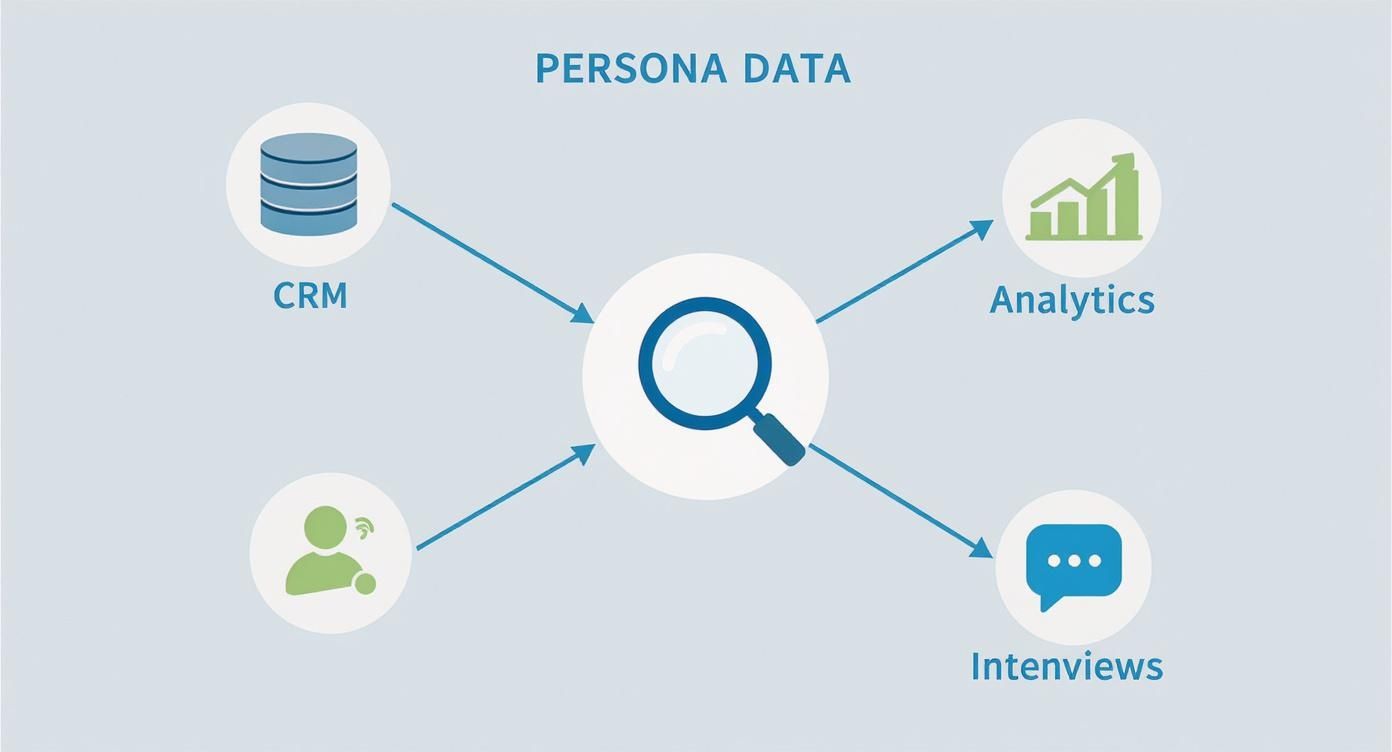
As the visual shows, the strongest personas aren’t built on just hard numbers or just gut feelings. They come from blending quantitative facts with qualitative human stories.
Finding Patterns and Commonalities
To get started, spread out all your qualitative feedback. Lay out your interview notes and open-ended survey answers, then grab a highlighter. Start tagging key phrases, frustrations, and specific goals. Don't stress about perfect categories yet; just hunt for repetition.
You might notice that five different marketing managers mention "proving ROI to my boss" as a huge source of anxiety. Or maybe you spot a trend where every operations lead brings up "integrating with our existing tech stack" as a dealbreaker. These are your first breadcrumbs.
Once you’ve tagged these insights, you can start grouping them. A simple spreadsheet or a tool like Miro works wonders here. Create a few columns to organize your thoughts:
- Job Role: This is usually the easiest place to start.
- Company Size/Industry: The pains of a startup founder are worlds away from those of an enterprise director.
- Pain Points: What problems are they actually trying to solve?
- Goals: What does a "win" look like for them, personally and professionally?
- Motivations: What’s the real driver behind their goals? Is it a promotion? Team efficiency? Not getting fired?
This clustering exercise will quickly show you the natural segments in your audience. You’ll stop seeing one generic "customer" and start seeing distinct groups take shape.
From Clusters to Archetypes
Let's make this real. Imagine a mid-market SaaS company just wrapped up 50 customer interviews. While sifting through the transcripts, they noticed three obvious clusters forming around one central problem: inefficient project management.
The "Overwhelmed Manager" Cluster: These folks kept talking about team burnout, missed deadlines, and having zero visibility into what anyone was doing. They used words like "chaotic," "disorganized," and "constantly putting out fires."
The "Executive Sponsor" Cluster: This group didn’t care about the daily grind. They were focused on budgets, resource allocation, and the strategic impact of projects. Their biggest headache? Not being able to get a clean, high-level report to justify their team's spending.
The "Individual Contributor" Cluster: These were the people on the ground, buried under clunky software and endless meetings. They just wanted a simple tool that would let them do their actual work instead of drowning in admin tasks.
By mapping these common pain points, the company uncovered three distinct persona archetypes from what they thought was a single customer base. This is the critical moment in learning how to create buyer personas that actually work—they’re representative, not generic. Each group has a different problem, needs different messaging, and cares about different features.
Defining Your Primary Persona
Once your archetypes emerge, it's tempting to treat them all as equals. That’s a mistake. You need to identify your primary persona—the single archetype that represents the heart of your market and is most critical to your success. This is usually the person feeling the most pain that your solution solves, or the one with the most sway in the buying decision.
Your primary persona is the main character in your marketing story. While other personas are important, every major strategic decision—from product roadmaps to campaign messaging—should be filtered through the lens of, "What would [Primary Persona's Name] think of this?"
For the SaaS company in our example, the "Overwhelmed Manager" was the clear choice for their primary persona. Why? Because that person felt the pain most acutely and was almost always the one who kicked off the search for a new tool, even if the "Executive Sponsor" had to sign the check.
The other two archetypes become your secondary personas. They're still incredibly valuable for tailoring specific content or running niche campaigns, but they aren't the main event. This focus keeps your strategy sharp. It stops your team from trying to be everything to everyone—a surefire recipe for connecting with no one.
Building Your Buyer Personas
You've waded through the research and spotted clear clusters in your audience. Now for the fun part: turning all that raw data into a story. This is where you breathe life into your archetypes, transforming them from abstract concepts into relatable characters your entire GTM team can get behind.
The real goal here is to build a shared reference point that creates genuine empathy. When your sales reps, marketers, and product managers can all picture the same person, their efforts just naturally click into place. This is a crucial part of learning how to create buyer personas that actually drive strategy instead of collecting digital dust.

Give Your Persona a Face and a Name
First things first, make them human. It might sound trivial, but assigning a name, a job title, and even a stock photo makes the persona feel less like a dataset and more like an actual person. These simple details are surprisingly powerful for building empathy across the team.
Try an alliterative name that’s memorable and hints at their role, like “Marketing Manager Molly” or “Startup Steve.” It’s a small touch, but it makes the persona much easier to talk about in meetings and strategy sessions.
Then, flesh out the basics:
- Job Title: Get specific. "Marketing Manager" is okay, but "Growth Marketing Manager" tells a much richer story.
- Industry & Company Size: Is she at a 50-person tech startup or a 5,000-employee enterprise? The context matters.
- Demographics: Include general details like age range, education, and location if your research showed these are important factors.
This foundational layer gives you the context for their world. While these details are important, the real magic happens when you dig into their daily grind, which is a key part of effective customer profiling.
Detail Their Daily Life and Core Motivations
Alright, now let's build out a more detailed profile of their professional world. This section moves beyond who they are on paper and explores what actually drives them every single day.
Start by outlining their main responsibilities and the objectives they're measured on. What does their boss expect them to deliver this quarter? What KPIs are they sweating over? Knowing their goals helps you frame your solution as the thing that gets them to success.
Next, document their biggest headaches and frustrations. These are the pain points you heard over and over in your interviews. Don't be afraid to use direct quotes from your research to make these challenges feel real and urgent.
A persona’s challenges section is your messaging goldmine. When you can articulate their problems better than they can, you instantly build trust and credibility.
Finally, list their go-to information channels. Where do they hang out online to learn and stay informed? This could be anything from specific LinkedIn groups and industry forums to podcasts or newsletters. Knowing their "watering holes" tells your marketing team exactly where to show up.
Weave in Psychographic Insights
The final layer is adding the psychographics—the attitudes, values, and hidden drivers that shape their behavior. This is what makes a persona truly three-dimensional.
Think about questions like:
- What are their personal career goals?
- Are they an early adopter of new tech, or more cautious?
- What's their primary motivation for finding a new solution (e.g., saving time, looking good to their boss, reducing stress)?
- What’s a potential dealbreaker for them during the sales process?
These insights help your team understand the emotional and psychological landscape of your buyer. They’ll inform everything from the tone of your ad copy to the way your sales reps handle objections.
For instance, an e-commerce brand we know identified a key persona they called “Growth Greg.” He was a marketing manager at a mid-sized retailer, and his biggest challenge was justifying his social ad spend to a skeptical CFO. His main motivation? To be seen as a data-driven innovator within his company.
That one insight guided their entire strategy. The marketing team ran A/B tests on ad copy, comparing creative that focused on brand awareness versus ROI metrics. The sales team built their entire demo around the platform’s advanced reporting features. This persona-driven approach led to a 35% increase in conversion rates from social campaigns because they were speaking directly to what Greg truly cared about.
Putting Your Personas to Work in Your GTM Strategy
Buyer personas are just fancy slide decks until they’re actually used. For them to have any real impact, they need to jump off the page and into the day-to-day work of your GTM teams.
Every single touchpoint, from an email to a product update, should be influenced by a persona insight. When that happens, you stop guessing and start connecting with the right people.
- Marketing can fine-tune content topics, like creating a webinar series specifically for the "Educator" persona.
- Sales reps can ditch generic scripts and adjust their email cadences to address specific persona pain points.
- Product managers can steer sprint priorities by focusing on user stories that solve real challenges for their key personas.
Aligning Content and Channels
This is where the rubber meets the road for marketing. Smart marketing leaders embed their personas directly into their editorial calendars, making them the North Star for every piece of content.
For instance, that "Educator" persona isn't going to care about a generic feature update. But they'll absolutely pay attention to a case study on new virtual teaching tools.
It’s about being strategic with your placement, too.
- Map their watering holes: Where do they actually hang out online? Think specific LinkedIn groups, niche newsletters, or industry podcasts.
- Match content to their habits: Does this persona prefer in-depth guides and webinars, or are they more likely to engage with quick-hit infographics and social media posts?
- Schedule distribution accordingly: Maybe you post thoughtful articles on LinkedIn weekly for your "Executive" persona while sharing daily tips on Twitter for your "Individual Contributor" persona.
Pushing out content without this context is just shouting into the void. You get scattershot engagement and wonder why nothing is sticking.
We’ve seen that persona-driven campaigns can generate 30% higher open rates and a significant uptick in qualified leads. It just works.
Better Sales Playbooks and Smarter Outreach
For sales reps, persona playbooks are a game-changer. They slash prep time and make every interaction more relevant.
Instead of starting from scratch, reps can pull from custom templates that speak directly to each persona’s core motivations and biggest headaches.
- Before drafting an email, they select the right persona profile.
- They lead with a core pain point in the opening line to grab attention.
- They use qualification questions designed to confirm if a prospect is a true fit for that persona.
One GTM team we worked with saw this approach cut their call prep time by 30%. That’s a massive efficiency gain. Short, persona-specific email sequences will outperform a one-size-fits-all cadence every time.
Prioritizing the Product Backlog
Product managers use personas to bring clarity to chaos. Instead of getting pulled in a dozen directions by feature requests, they can ground their decisions in what will actually serve their target customers.
They do this by tagging backlog items with persona labels. Suddenly, it’s crystal clear which user stories help which customer.
- Every user story gets a persona code.
- Features are ranked based on how many key personas they impact.
- Sprint goals are reviewed through a persona lens during every planning session.
This simple alignment prevents feature bloat and keeps the team focused on building things people genuinely want. A fintech team, for example, built a "Financial Sam" persona and used his specific challenges to design a budgeting tool that was an instant hit.
The value here extends far beyond just marketing. When you truly understand your ideal customers, you can build better products and even refine your pricing. Simon-Kucher found that one fintech company used personas to overhaul its offerings, leading to a forecasted 29% revenue bump and a 15% lift in new customers. You can read more about their buyer personas blueprint here.
| GTM Function | Persona Focus | Measurable Impact |
|---|---|---|
| Marketing | Content topics aligned to persona needs | 25% more MQLs |
| Sales | Outreach templates based on persona cues | 30% reduction in prep time |
| Product | Feature backlog prioritized by persona | 29% forecasted revenue lift |
When you create concrete playbooks and templates, the whole GTM engine starts humming in unison.
Embedding personas into your daily workflows is what transforms them from vague ideas into a powerful tool for cross-team alignment.
Don't Set It and Forget It: Measurement and Iteration
Personas aren't a one-and-done project. They need to be living documents. Tracking persona-driven KPIs is the only way to make sure they stay relevant and accurate.
Tie your key metrics back to persona outcomes to see what's really moving the needle.
- Segment your email analytics by persona. Are open rates, click-throughs, and conversions higher for one group versus another?
- Gather constant feedback from sales calls and product usage data to see if your persona assumptions hold up in the real world.
- Schedule a persona audit every quarter with people from marketing, sales, and product to share fresh customer insights.
Iteration is what keeps your personas alive.
Our data shows that regularly reviewing and updating personas can boost campaign ROI by as much as 20%.
When your GTM strategy is woven with persona insights, you naturally adapt as your customers' needs change. To get started, make it easy and make it consistent. Integrate the profiles into marketing briefs, sales scripts, and product roadmaps.
Give each department a clear "persona owner" to drive accountability. Then, just start. The small wins will stack up quickly.
Got Questions? We've Got Answers
Even with the best framework, a few common questions always seem to pop up when building buyer personas. Let's tackle the big ones your team will probably run into, from figuring out the right number of personas to making sure they don't get stale.
Getting these details right is what turns your personas from a neat marketing exercise into a powerful tool that actually drives growth.
So, How Many Buyer Personas Do We Really Need?
This is easily the most common question I hear, and my answer is always the same: quality over quantity. There's no magic number, but most companies hit the sweet spot with three to five core personas.
Why that range? It’s enough to cover your main audience segments without getting watered down, but it’s also a manageable number for your team to actually remember and use. If you create a persona for every tiny customer variation, the profiles lose their punch and just become too complicated to be helpful.
A great way to start is by defining your single primary persona—the one that represents the absolute heart of your market. Build your core strategies around them first. Then, you can layer in secondary personas to cover other important segments.
Pro tip: If you notice two of your draft personas have nearly identical goals, challenges, and motivations, that’s a huge sign they should be merged. Keeping things focused is key to crafting messaging that truly connects. Over-segmenting right out of the gate will only dilute your efforts.
What’s the Difference Between a Buyer Persona and an ICP?
It's super easy to mix up a buyer persona with an Ideal Customer Profile (ICP), but they play two very different—and equally important—roles, especially in B2B.
Think of it this way: the ICP is the company you sell to, and the buyer persona is the person you sell to within that company.
An Ideal Customer Profile (ICP) is all about the perfect-fit company. It’s built on firmographics—the hard, company-level data that makes an organization a fantastic match for what you offer.
- Industry: Which sectors get the most value from your product? (e.g., SaaS, Healthcare, E-commerce)
- Company Size: How many employees do your best customers typically have? (e.g., 50-200 employees)
- Revenue: Is there a specific annual revenue you target? (e.g., $10M-$50M ARR)
- Geography: Are your solutions better for companies in a particular region?
A buyer persona, on the other hand, zooms in on the individual decision-maker or influencer working at that ideal company. It’s a sketch that brings their human side to life: their personal goals, what keeps them up at night, their job responsibilities, and what really motivates their buying decisions.
So, your ICP tells your team which accounts to go after. Your buyer personas tell them how to talk to the actual people at those accounts in a way that resonates.
How Often Should We Update Our Personas?
Buyer personas aren't something you create once and frame on the wall. Markets change, customer needs shift, and new tech rewires how people work. Your personas have to be living documents, not a "one-and-done" project.
As a general rule of thumb, plan to formally review and refresh your personas at least once a year. This keeps them from becoming stale and irrelevant.
But some events should trigger an immediate update, no matter where you are in your annual cycle.
- A Major Market Shift: Think economic downturns or new industry-wide trends. These can completely change your customers' priorities.
- A New Product Launch: When you roll out a major new feature or product, you might start attracting a whole new type of buyer.
- Entering a New Market: Expanding into a new country or industry vertical almost always means you'll need new or heavily tweaked personas.
The best way to keep your personas fresh is to build a continuous feedback loop. Your sales and customer service teams are on the front lines, hearing about new challenges every single day. Create a simple way for them to pass those insights back to the marketing or product teams. This kind of ongoing, small-scale updating is way more effective than a massive overhaul every few years.
Ready to stop guessing and start finding high-intent leads who match your buyer personas? Intently uses AI to monitor millions of conversations on Reddit, X, and LinkedIn, alerting you the moment potential customers talk about the problems you solve. Discover your next customer with Intently.ai.